
Shape 05
Public Goods and the Free Rider
A non-excludable, non-rival good: contribution is privately costly and the return is shared, so it is underprovided.
Underprovision here is a structural prediction, not a moral failing, and the fix is structural too. Note that trust in a shared resource does not decay gradually — it collapses, because visible non-contribution changes everyone's expectation at once. Empirically, contributions in repeated public-goods experiments start well above zero and decline steadily, and the decline is driven by conditional cooperators withdrawing when they observe free riding, not by selfish players discovering the dominant strategy.
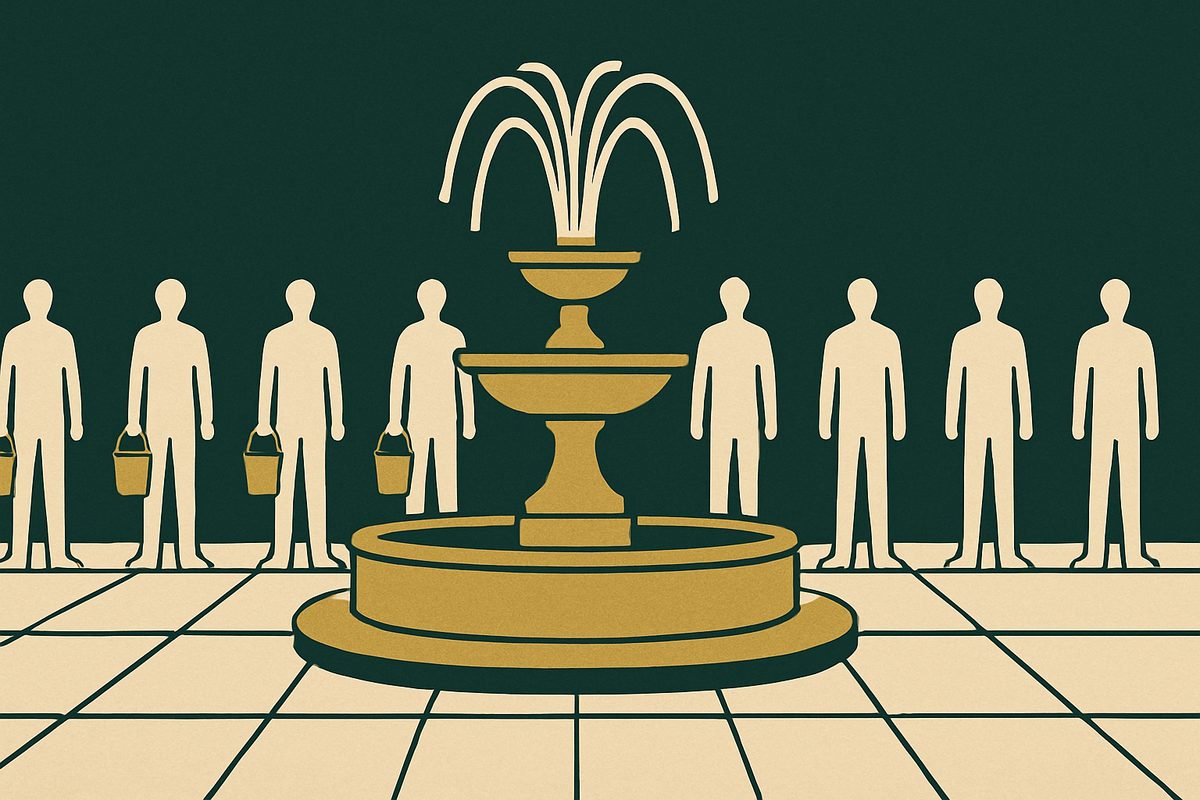
- How it feels
- The benefit arrives whether or not you personally did anything.
- Nobody can be excluded from it, and nobody tries to be.
- The people contributing are visibly the same few every time.
- Everyone agrees it is worth having and nobody will fund it.
- Who is playing
- The contributors, the non-contributors, and — nearly always omitted — whoever could make contribution visible or make the good excludable. Groups small enough to notice each other solve this far more often than large ones.
- Where it lands
- The good is underprovided, the reliable few burn out, and the resource thins until it stops being worth having.
- What moves it
Make contribution observable, shrink the group, tie the benefit to the contribution, or fund it compulsorily. Ostrom's field work shows that self-governing groups solve it reliably when they can monitor each other cheaply and impose graduated sanctions — the conditions matter more than the culture.
Not to be confused with
Nearly every misread in practice is a shape mistaken for its neighbour — and each of those mistakes points you at the wrong fix.
The Commons
Is the problem that people take too much, or that they contribute too little? Taking too much from a shared stock is a commons; failing to fund a shared benefit is this.
The Stag Hunt
Does the good arrive if only some contribute? If it needs everyone at once, it is a stag hunt and assurance fixes it.
Where you have already met it
News and Media
Public-interest journalism. Everyone benefits from it existing; almost nobody's personal payment determines whether it does.
Health and Medicine
Vaccination. The protection is partly collective, so each individual's cost-benefit differs from the group's.
Work and Careers
The office kitchen. Somebody has to clean it and no individual has ever had a reason to be that person.
Climate and Shared Resources
Clean air. The archetype: costly to provide, impossible to withhold, and consumed by everyone regardless.